NTU Bio-Tech

:::
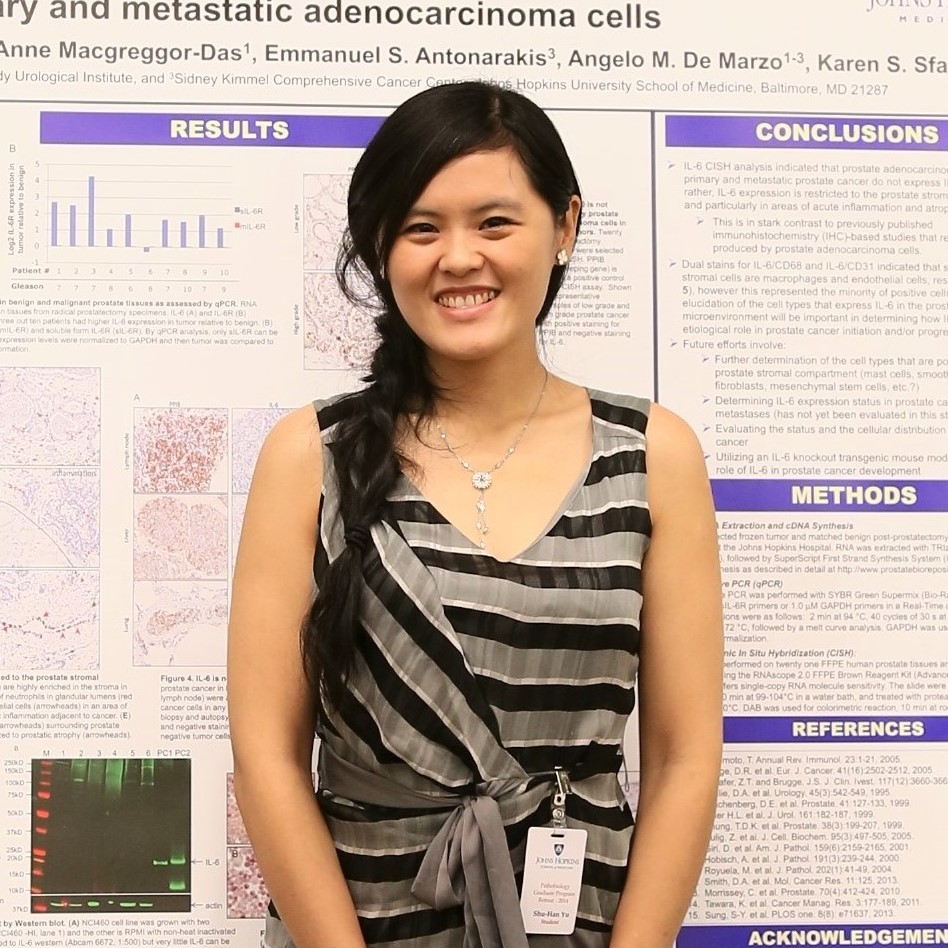
Shu-Han Yu
Job Title Associate Professor
Name Shu-Han Yu
Office Tel No. 886-2-3366-6007
Email
Personal Website https://shuhanyu.wixsite.com/website
Experience Assistant Professor, National Taiwan University,Institute of Biotechnology, Taiwan, 2020.02 ~ PresentPresent

Assistant Professor, National Defense Medical Center, Graduate Institute of Life Science, Taiwan, 2018.08 ~ 2020.01
Education Pathobiology, Johns Hopkins University,School of Medicine, Baltimore, MD, USA, 2010.07 ~ 2015.03
Discipline Immunological Techniques: Antibody Tools
Stem Cell Biology 
Seminar 
Research expertise Tumor Microenvironment
Spatial Biology 
Personalize Medcine 
Autobiography

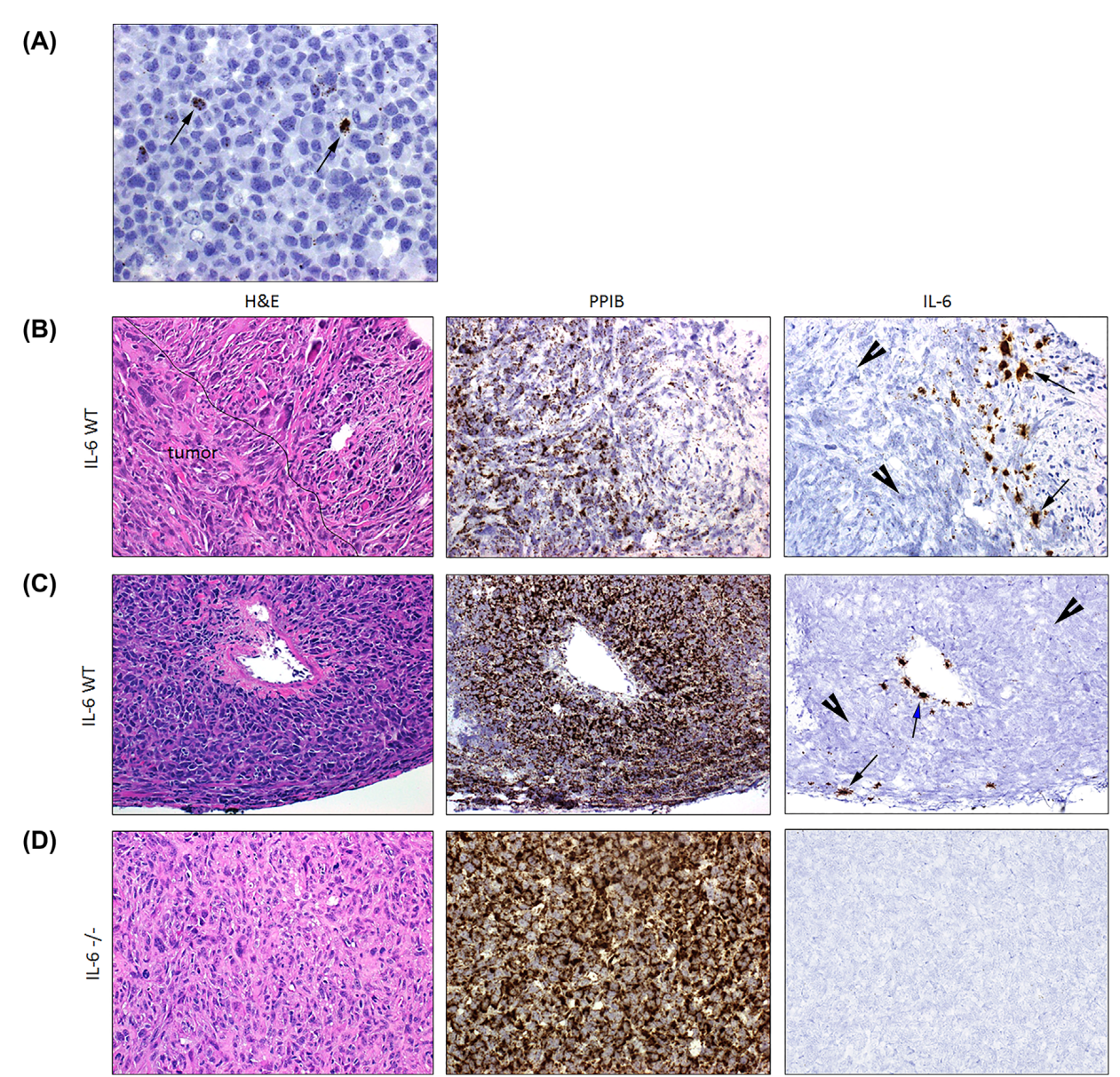
Associate Professor Shu-Han Yu’s Laboratory (The S.H.Y. Lab) focuses on two major research areas: the tumor immune microenvironment (TIME) and personalized medicine. The laboratory integrates high-throughput spatial transcriptomics with AI-guided multiplex immunohistochemistry to investigate the spatial organization and cellular interaction patterns within the tumor microenvironment. Through this platform, the lab aims to reconstruct functionally relevant immune microdomains, or immuno-clustering patterns, within the TME and further analyze the spatial proximity and interactions among different cell populations in these regions, enabling high-resolution spatial biology research.
This is an image

The tumor immune microenvironment consists of tumor cells, tumor-infiltrating immune cells, cancer-associated fibroblasts, tumor vasculature, and extracellular matrix components. Together, these cellular and non-cellular elements regulate tumor immune evasion, promote tumor growth and metastasis, and influence patient responses to therapy. Therefore, systematic analysis of the immune cell composition and spatial distribution in patient tumor tissues and surrounding tissues can help establish a standardized platform for TIME analysis and further support the development of precision medicine and personalized therapeutic strategies.
圖片 1

The tumor microenvironment research platform established by Dr. Yu’s laboratory can be applied to the investigation of tumor biology and therapeutic mechanisms in canine and feline cancers, as well as other disease models. This platform is also integrated into the laboratory’s long-standing research on oral squamous cell carcinoma (OSCC). By analyzing the spatial organization of the tumor immune microenvironment and immune cell interaction patterns in OSCC patient tissues, the lab aims to evaluate their potential as predictive indicators of immunotherapy response. These research outcomes may help clinicians develop more precise personalized diagnostic and treatment strategies based on the unique TIME features of each patient, thereby reducing unnecessary drug use and treatment costs while minimizing potential side effects associated with high-dose, long-term, or continuous medication.

圖片 1

Translational Drug Discovery and Multi-Stage Screening for Idiopathic Pulmonary Fibrosis

Idiopathic pulmonary fibrosis (IPF) is clinically characterized by a high mortality rate and currently remains incurable. Although pan-histone deacetylase (pan-HDAC) inhibitors have demonstrated potential in slowing disease progression, their lack of selectivity often leads to severe adverse effects, such as hepatotoxicity and skin toxicity. To address this clinical bottleneck, this study collaborates with Professor Chao-Wu Yu’s team from the School of Pharmacy at our university. We have successfully designed and synthesized a series of novel, selective inhibitors targeting HDAC4, HDAC5, HDAC6, HDAC7, HDAC8, or dual HDAC6/8, aiming to minimize off-target effects and enhance therapeutic safety through precise epigenetic regulation.

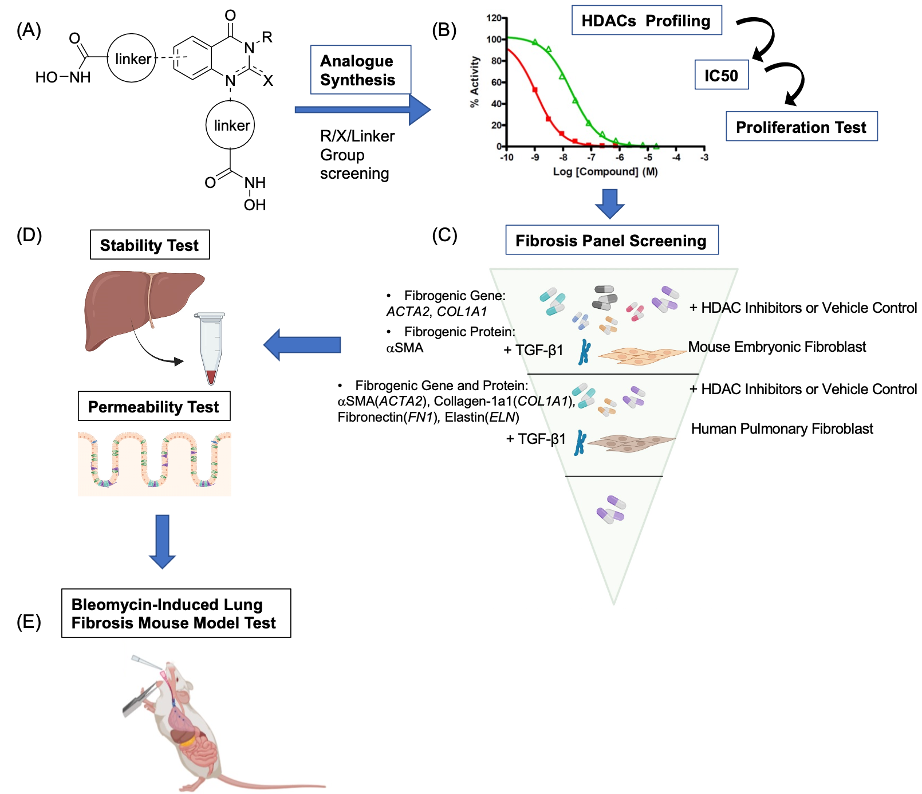
To efficiently identify candidates with clinical potential, our team established an innovative three-stage drug screening platform to systematically accelerate drug development and reduce costs.

  • In the first stage, mouse embryonic fibroblasts (NIH-3T3) were utilized for initial pre-screening against TGF-β1-induced fibrosis, successfully identifying hit compounds from the small-molecule library.

  • In the second stage, human pulmonary fibroblasts (HPF) were employed for further efficacy validation, integrated with early drug metabolism and pharmacokinetics (DMPK) evaluations—specifically Caco-2 cell permeability and liver microsomal stability assays—to precisely narrow down the pool to the final two lead compounds possessing high stability and permeability.

  • In the third stage, a molecular docking approach and a bleomycin-induced pulmonary fibrosis mouse modelwere implemented for in vivo validation of these lead compounds.

Our findings demonstrate that the identified key lead compounds significantly inhibit TGF-β1-induced proliferation of pulmonary fibroblasts and effectively downregulate the expression of fibrosis-associated proteins, thereby mitigating the progression of pulmonary fibrosis in mouse models. This comprehensive drug discovery pipeline—which seamlessly integrates chemical synthesis, multi-stage in vitro efficacy and pharmacokinetic screening, and in vivo disease model validation—lays a critical foundation for applying selective HDAC inhibitors to anti-fibrotic therapies. Looking forward, it holds great promise for developing highly effective, non-toxic, and innovative targeted drugs, ultimately improving the quality of life for patients suffering from IPF.
This is an image
Year Paper Title
2025 High-selective HDAC6 inhibitor alleviates bone marrow fibrosis through inhibiting collagen formation and extracellular matrix deposition. , Scientific Reports., 2025
2025 Atezolizumab, bevacizumab, pemetrexed and platinum for EGFR-mutant NSCLC patients after EGFR TKI failure: A phase II study with immune cell profile analysis., Clinical and Translational Medicine. , 2025
2024 IdIdentification of anti-fibrotic and pro-apoptotic bioactive compounds from Ganoderma formosanum and their possible mechanisms in modulating TGF-β1-induced lung fibrosis., Journal of Ethnopharmacology. , 2024
2024 Evaluation of the amelioration effect of Ganoderma formosanum extract on delaying PM2.5 damage to lung macrophages. , Molecular Nutrition & Food Research., 2024
2024 Alleviation of PM2.5-induced alveolar macrophage inflammation using extract of fermented Chenopodium formosanum Koidz sprouts via regulation of NF-κB pathway. , Journal of Ethnopharmacology., 2024
2023 Glycine-rich peptides from fermented Chenopodium formosanum sprout as an antioxidant to modulate the oxidative stress. , Journal of Food and Drug Analysis., 2023
2023 Discovery of HDAC6, HDAC8, and 6/8 Inhibitors and Development of Cell-Based Drug Screening Models for the Treatment of TGF-ß- Induced Idiopathic Pulmonary Fibrosis., Journal of Medicinal Chemistry., 2023
2023 Effects of selective cyclooxygenase-2 inhibitor robenacoxib on primary cells derived from feline injection-site sarcoma., Cell Mol Med., 2023
2023 Neoantigen vaccination augments antitumor effects of anti-PD-1 on mouse hepatocellular carcinoma., Cancer Lett., 2023
2023  Production and analysis of metabolites from solid-state fermentation of Chenopodium formosanum (Djulis) sprouts in a bioreactor. , Food Research International., 2023
2022 The role of cytokines and chemokines in severe acute respiratory syndrome coronavirus 2 (SARS-CoV-2) infections., Frontiers in Immunology., 2022
2021 Hsu PS, Yu SH, Tsai YT, Chang JY, Tsai LK, Ye CH, Song NY, Yau LC, and Lin SP. 2021. 28(1):58. (co-first author 第一作者), More than causing (epi)genomic instability: emerging physiological implications of transposable element modulation. , J. Biomed. Sci., 2021
2021 Enhanced antioxidant activity of Chenopodium formosanum koidz by lactic acid bacteria: optimization of fermentation conditions. , PLOS One., 2021
2021 2021
2019 Yu SH, Maynard JP, Vaghasia AM, De Marzo AM, Drake CG, Sfanos KS, A role for paracrine interleukin-6 signaling in the tumor microenvironment in prostate tumor growth, Prostate, 79, pp. 215-222, 2019
2019 Korangath P, Barnett J, Sharma A, Henderson E, Stewart J, Yu SH, Kandala SK, Yang CT, Caserto JS, Hedayati M, Armstrong TD, Jaffee E, Gruettner C, Zhou XC, Fu W, Hu C, Sukumar S, Simons BW, and Ivkov R., Nanoparticle interactions with immune cells dominate tumor retention and induce T cell-mediated tumor suppression in models of breast cancer(In press), Science Advances, 2019
2018 Shrestha E, White JR, Yu SH, Kulac I, Ertunc O, De Marzo AM, Yegnasubramanian S, Mangold LA, Partin AW, Sfanos KS, Profiling the urinary microbiome in men with positive versus negative biopsies for prostate cancer, J Urol, 199, pp. 161-171, 2018
2015 Sfanos KS, Canene-Adams K, Hempel H, Yu SH, Simons B, Schaeffer A, Schaeffer E, Nelson G, De Marzo AM, Bacterial Prostatitis Enhances 2-Amino-1-Methyl-6-Phenylimidazo[4,5-b]Pyridine (PhIP)-Induced Cancer at Multiple Sites., Cancer Prev Res (Phila), 8, pp. 683-692, 2015
2014 Le A, Stine ZE, Nguyen C, Afzal J, Sun P, Hamaker M, Siegel NM, Gouw A, Kang BK, Yu SH, Cochran RL, Sailor KA, Song H, Dang CV, Tumorigenicity of hypoxic respiring cancer cells revealed by a hypoxia-cell cycle dual reporter, Proc Natl Acad Sci U S A, 111, pp. 12486-12491, 2014
2013 Shinohara DB, Vaghasia AM, Yu SH, Mak TN, Brüggemann H, Nelson WG, De Marzo AM, Yegnasubramanian S, Sfanos KS, A mouse model of chronic prostatic inflammation using a human prostate cancer-derived isolate of Propionibacterium acnes, Prostate, 73, pp. 1007-1015, 2013
2012 Mak TN*, Yu SH*, De Marzo AM, Brüggemann H, Sfanos KS, Multilocus sequence typing (MLST) analysis of Propionibacterium acnes isolates from radical prostatectomy specimens, Prostate, 73, pp. 770-777, 2012
Honor Category Year Award Name Awarding Unit
Inside School Honor 2025 The 5th CH Biotech Innovation Awards (Innovative Application Category) 正瀚生技創新獎 正瀚生物科技
Inside School Honor 2023 Research Collaboration, COCKPI-T Funding Takeda Pharmaceutical Company Limited
Outside School Honor 2018 Young Scholar Fellowship Ministry of Science and Technology
Outside School Honor 2013 Excellence in Translational Research, Young Investigator Award
Outside School Honor 2012 Government Scholarship (公費留考) Ministry of Education
Outside School Honor 2012 Singapore-Global Young Scientist Summit, Singapore Government Travel Award
Outside School Honor 2010 Young Scientist Award 17th East Asia Joint Conference on Biomedical Research
Outside School Honor 2006 Undergraduate Research Fellowship Republic of China National Science Council
The P.I. Shu-Han Yu
This is an image
Ph.D. Student 

Chih-Hung Ye (D6)
This is an image

Patrick Chong (D3) 
LINE_ALBUM_Update the website picture_260608_1

Master Student 

Tsai Yen-Chun (M2)

Nguyen Le-Bao-Long (M2) 
LINE_ALBUM_Update the website picture_260608_2

Ho Nguyen Van Tan (M2)
LINE_ALBUM_Update the website picture_260608_4

Rico Laurance (M1)
LINE_ALBUM_Update the website picture_260608_3

Yu-Zhi Tai (M1)

Shu-Yen Yeh (M1)


Previous Lab Members 

Guan-Ru Peng (2022 Master Graduate)
This is an image
Wei-Chieh Yu (2023 Master Graduate)
This is an image
Wei-Ting Chen (RA)
This is an image

Wei-Chen Lin (RA)
This is an image

Vincy Kao